
King George Current Owner Record
An owner record is an administrative snapshot, not a complete ownership opinion. The Commissioner updates parcel details and transfers whenever a deed or will is recorded with the Circuit Court Clerk. No fixed refresh interval between deeds and the roll is published. Treat the owner field you actually see as dated. Note the day of your property search. A snapshot with a date beats a guess.
| Owner name shown | Copy the owner field as displayed; the live field label can vary |
|---|---|
| Mailing address | Address used for tax notices or owner correspondence |
| Situs address | Physical location assigned to the parcel |
| Map or parcel number | Cross-reference for the Commissioner, Treasurer, GIS, and deed index |
| Recorded deed | Latest instrument pointer, grantor, grantee, and legal description |
| Search date | Date the assessment or index view was checked |
The owner of record in King George is not always the occupant. The situs address describes the land. The mailing address may point to a trust, business, estate, or absentee owner. Neither proves anyone lives there. The mailing address is the better clue for lawful property notices. Start at the My Property hub.
King George Commissioner Owner Snapshot
The Commissioner of the Revenue keeps the current real-estate assessment for King George County, updates parcel details and owner addresses, prepares the annual land book, and transfers ownership whenever a recorded deed or will changes hands. That makes the Commissioner's record the best starting point for a current owner of record. The county's tax inquiry can also return a taxpayer name tied to an account. Treat that label as a billing view. The latest grantee on a recorded deed may differ from the name on the tax bill.
The office sits at 10459 Courthouse Drive, Suite 101, King George, Virginia 22485, and its published phone is 540-775-4664. Walk-in hours run weekdays from 8 a.m. to 4 p.m. The county's property hub ties the GIS map and tax tools together in one place. The office publishes no fixed card field list or owner-update schedule, so treat any result as a point-in-time view rather than a guarantee of same-day accuracy.
Confirm the Current Owner in King George
Confirming who owns a King George parcel means comparing the current roll with the most recent recorded conveyance. Start with the parcel number. Note the owner the Commissioner or Treasurer lists. Then search the Circuit Court Clerk's index for the grantee and legal description. Inspect the deed image if the index pointer is ambiguous. A recent conveyance may not have reached the land book or billing account yet. The freshest deed wins.
- Record the owner name, parcel number, situs address, and date shown on the county roll.
- Search the free deed index for the newest instrument matching the grantee and parcel description.
- Read the deed’s grantor, grantee, document date, recording date, and legal description.
- Ask the Commissioner or Clerk to resolve a timing or name discrepancy before relying on the result.
- Owner of record
- The name appearing in the county’s administrative or recorded source.
- Vesting
- The way a deed identifies the grantee or grantees receiving an interest.
- Registered agent
- A contact listed for an entity; the listing does not prove beneficial ownership.
King George Owner Records Can Lag Deeds
No county figure states how long a deed takes to reach the tax roll. A recent recording can be the newest ownership event. The Commissioner's screen may still show an earlier name. Compare recording and instrument dates. A deed can be signed long before it is recorded. If the dates or names conflict, do not guess. Ask the Clerk about the index entry. Ask the Commissioner about the administrative record.
The Land Records page notes that the free index omits document images and explains how to request a copy. Copies at the clerk's office cost $0.50 per page. Certification adds $2. Remote images require a paid subscription. The free index works well as a first locator. The full instrument lets you compare the legal description and the named parties.
Keep the instrument reference with its recording date. Later, you can match any roll change to that same deed.
King George Entity Owner Records
A current grantee may be an LLC, corporation, trust, estate, or fiduciary. Virginia's SCC Clerk's Information System searches entities by Entity Name or Entity ID. Its filing history lists record dates and entity documents. The public entry may show a registered agent and principal office. Those details describe the state filing. They say nothing about who lives there.
For an estate, the Circuit Court Clerk handles probate matters by appointment. Look for a will, qualification order, or fiduciary deed. A death certificate does not convey land. Match the legal description and parcel number even when the fiduciary's name differs from the deceased owner in an older tax record. The official business lookup is the Virginia SCC entity search.
King George Owner Name Alerts
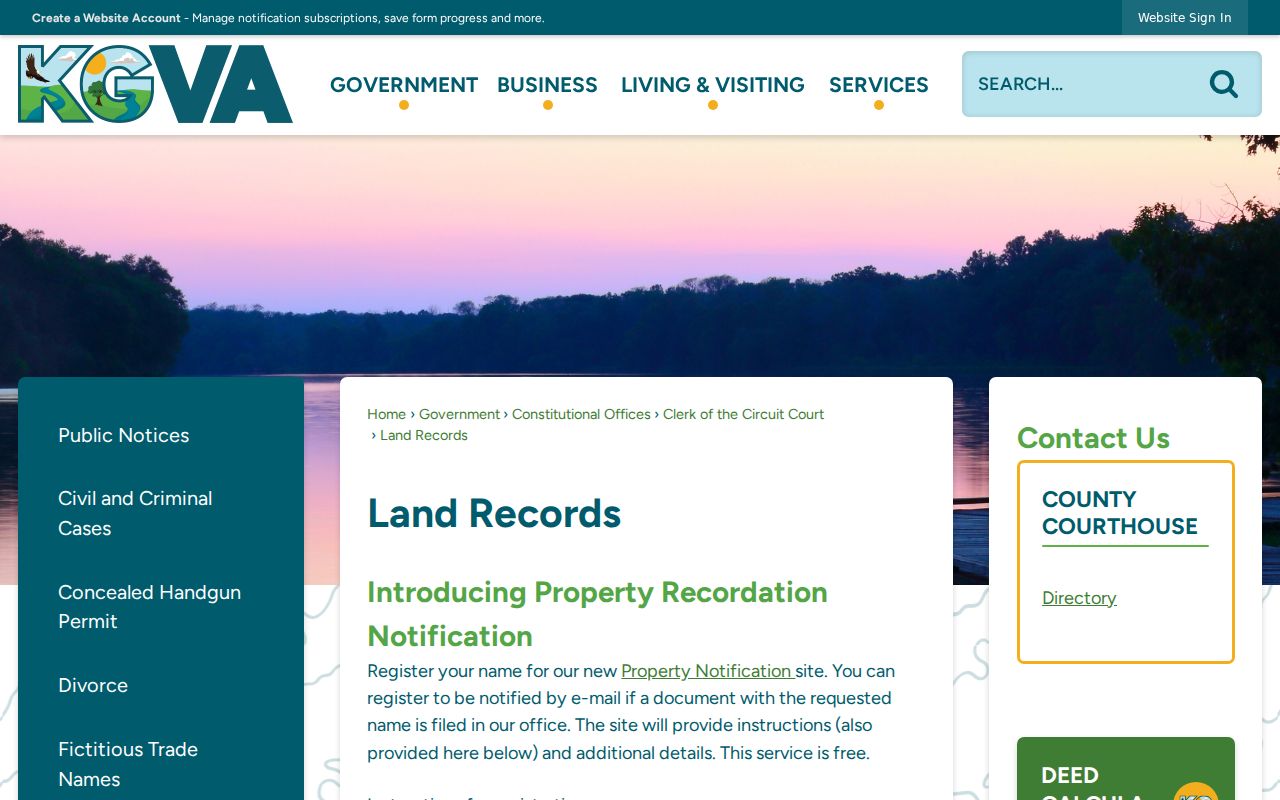
The Clerk offers a free Property Recordation Notification service. It emails a subscriber. It fires when a watched person or business name shows up in a new land-record filing. Setup takes an account and an email address. From there, add the names to monitor. This works well after a deed is recorded. It also suits an owner who wants word of a later document. One limit: it follows names, not a parcel map number.
An alert is a prompt to check the index. It is not proof that a property changed owners. Compare the instrument reference and the legal description. A common name or business may belong to a different tract. The service does not stop a recording or replace review of the latest deed. Its registration instructions sit on the county's Land Records page.
Reach the King George Owner of Record
For written contact, use the mailing address shown in the county record, and keep the message tied to the land, an assessment, or a recorded instrument. That address may be a business, a fiduciary, an attorney, or an out-of-county location. Treat it as a mailing point. It is not a home address. It will not identify occupants either. Virginia runs an Address Confidentiality Program for qualified participants, and some records carry added access restrictions.
Routing matters. A tax account issue goes to the Treasurer. Assessment questions go to the Commissioner. A deed or recorded instrument belongs with the Circuit Court Clerk; the county pages identify the right custodian and keep private details from going to an unrelated office.
The Commissioner keeps the real-estate land book. That office transfers property as recorded by deed or will and updates owner addresses. It is the right place to raise a tax roll or mailing-address discrepancy, while the Treasurer can confirm whether a tax notice or payment appears on the billing account. The Clerk can locate the instrument itself. Keep these questions separate. A recent deed is not an updated tax balance, and a payment record is not proof of title.
In your letter, include the map number. Add the name currently shown and the instrument's recording date if you have it. The county publishes no fixed deed-to-roll update interval. Ask whether that specific transfer has reached the land book rather than assuming a set number of days. For a title question, use the recorded deed. For an address correction or notice issue, use the Commissioner's administrative record.
Lawful use. Use owner-of-record information for property matters and civic research. Do not use a name or mailing address to stalk, threaten, intimidate, or harass anyone.